
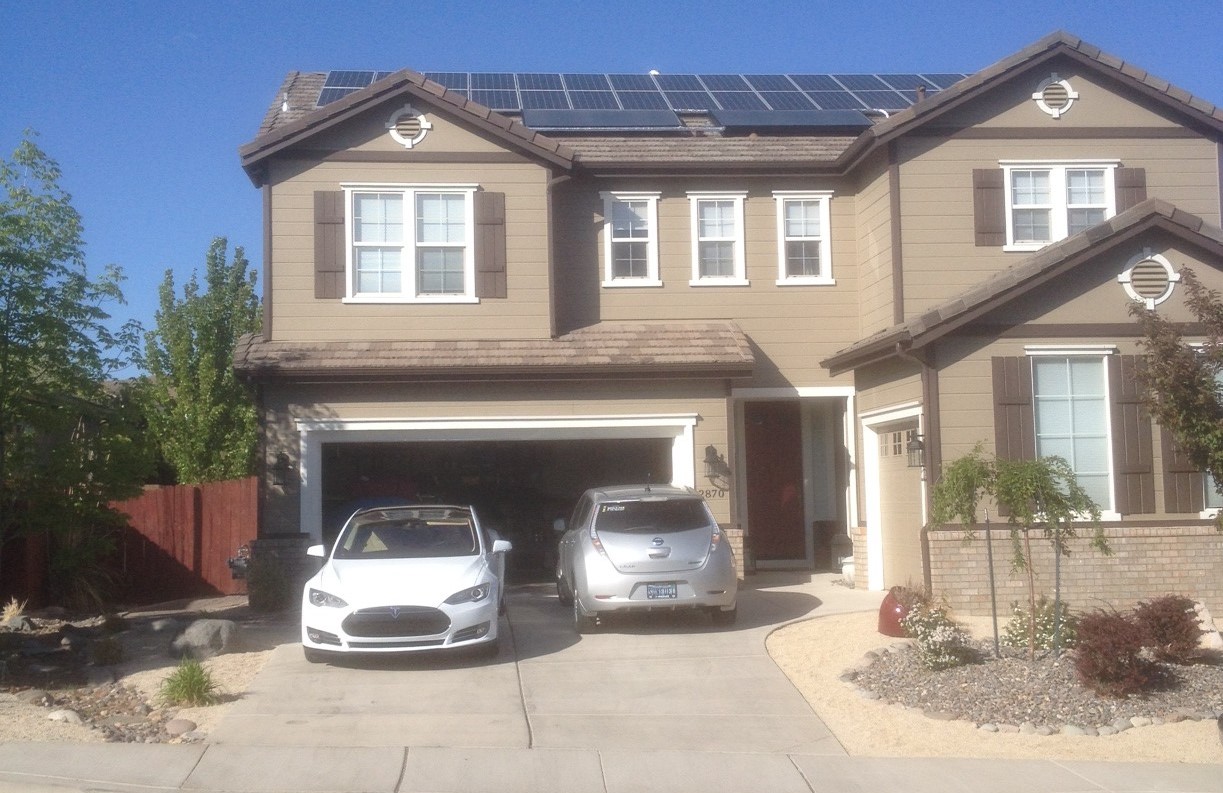
Net metering is where a homeowner (or other utility customer) places solar panels on their rooftop (or in the yard). These panels provide energy that effectively “spins the meter backward” during the day. At night, when the sun doesn’t shine, the meter spins forward. This customer pays the “net” of energy used from the utility minus the energy supplied to the grid during the day.
Net metering is under attack across the country. The primary argument is that net metering customers don’t pay their fair share for the “grid” (since most net metered customers only pay the monthly service charge). The claim is that other customers end up shouldering the “grid” costs and net metered customers skate by for virtually free. This can be a complex discussion and we’ll skip it for now (just remember it isn’t that simple).
By bringing electric vehicles into the equation, net metering works very well for ALL customers. How can this be? If done correctly, the cars consume the same amount of energy that the solar panels generate. So, a home with electric cars and solar panels uses the same amount of grid energy as a home without either. This means both houses pay their fair share for the “grid”.
But it gets even better than that. Energy on the grid is cheaper at night (supply & demand). As we are sleeping and our EVs are charging, the utility is getting a lower than average cost on that energy. During the day, when energy is more expensive, the solar panels are offsetting (lowering) the amount of expensive “peak” energy the utility needs to purchase. The net effect is that homes with solar panels and electric cars typically lower the cost of energy required to serve them – and this helps lower the cost for all customers. This is a longer, more complex story – but this is the short version.

 Let's Fix This Planet